Showing posts with label War. Show all posts

Monday, July 2, 2012

The Unbreakable Shell


John Wayne does three things well.

He talks with a languid toughness that manages to sound both intimidating and wise at the same time and whenever he struts across the screen as a soldier or cowboy he comes across as completely legitimate, despite the painful obviousness in many of his performances.


In 1949’s Sands of Iwo Jima, Wayne puts his best boot forward – and collected an Oscar nomination in the process – when he offers up equal doses of stoicism and sympathy in his now-legendary role as the no-nonsense Marine Sergeant Stryker. It is not an exaggeration to say that the very stereotype of the hard-as-nails drill instructor originates with Wayne and this performance. It is also not an exaggeration to assert Wayne being Wayne in this film is precisely what saves an effort that otherwise would be a profound piece of propaganda celebrating the legend of the Marine Corps.

Because as I said, this is not altogether incredible stuff.


There is a kind of paint-by-numbers with these World War Two epics: The platoon or company is always the center of our attention and it is typically comprised of souls with immediately identifiable accents and at least one personality trait that enables the viewer to remember something unique about that character when he is spotted among the rest of the cast. Part of this is economy, because nobody needs a film with a dozen developed characters, and part of it is filmmakers giving the audience what they expect from the genre (see Saving Private Ryan). Sands of Iwo Jima may be decades old and made within living memory of the actual event, but quite a lot of World War Two films had already appeared by 1949, many of them with Wayne in them, and Hollywood knew what people wanted. More complicated war films, with less obvious tracks, would not come until America began to grapple with how to depict the Vietnam conflict on the screen.


In the case of this film, the American triumph on the tiny island of Iwo Jima signified by the iconic flag-raising ceremony on the summit of Mt. Suribachi was known to virtually every American. The photograph, taken by Joe Rosenthal, had not only graced magazine covers and posters, it had also been used extensively as propaganda piece to raise war bonds (see Flags of My Father). The decision to graft a challenging, if somewhat one-dimensional and episodic plot, on top of a film building to an inevitable event therefore deserves some credit. Stryker could have been more boorish and more boring, and in the hands of a lesser actor he might have been.


Wayne makes him believable and he does not with his bark but with the pained scowl he gets whenever he is confronted by another’s failure to perform or on the occasions when the awfulness of failure attempts to impose itself on his life and the fate of his men. There is a telling scene when Wayne encounters a baby belonging to Julie Bishop after a brief romance in her home. The father is gone, either dead or disinterested, and Wayne is painfully reminded of his own estrangement from his child, and haunted by the possibility that he too may one day leave a woman without a man and a child without a father, should he fall combat.

The scene plays well on Wayne’s running confrontation with John Agar, the arrogant, college-educated son of an officer under whom Wayne served. Agar is the smart-aleck recruit who presents his sergeant with a problem. This would feel stale and prosaic were the father/son motif not the foundation of the turmoil. Wayne watched an officer he loved as a father die, and now the son of that officer is under his care. What is he to do? The answer is make certain the son is ready.


On the American side, the battle of Iwo Jim claimed upwards of 6,000 men and 19,000 casualties, including the lives of most of the men in the famous flag-raising photograph. All but 200 or so of the 20,000 Japanese soldiers on the island died in combat. The latter of the two statistics speaks to what manner of battle the American Marine faced on the island – the enemy, almost literally, was willing to fight to the last man, and nearly did so. America's triumph should be viewed in martial terms that take into account those horrific numbers, but also in the more human tones painted in this film. When Wayne, rather inevitably, falls, his men find a letter on him addressed to his estranged son, saying all the things he wanted to say but could not find the strength to do so while he was alive. It is a cliched moment perhaps, but it still makes the audience feel nonetheless. Here is a tireless warrior, a man among men who trained other men to do great things. And here, laid bare, in a letter he knew could only be posted after he died, is his soul. He was unbreakable as a Marine, but even Marines are people, too.

Monday, December 5, 2011

The End of Something?

Hollywood’s fascination with the ancient world makes cinematic sense.

Films are comprised of a great many elements, but above all else, they are visual journeys to a proscribed reality representing a time and place different from our own. Even a contemporary film about contemporary times is artificial in the sense that any narrative structure, by definition, is a representation of reality – not reality itself. Along these lines, it is not surprising filmmakers love costumes and settings that allow them to dabble in world-making, and if one is going to whisk the audience away to somewhere else, why not some other time? But even these points cannot truly account for the spate of sword and sandal films that erupted in the wake of D. W. Griffth’s Intolerance and continued to land on the screen for almost 60-plus years (longer if we include Ridley Scott’s Gladiator and HBO’s Rome). 

Ancient Babylon, from Intolerance.
What else is at work, I suspect, is an attraction to grandeur and momentousness, both of which are tough to spot in one’s own contemporary existence, where and when we tend to remain unimpressed with ourselves – or at the very least, accustomed to our own achievements and challenges. Thus, chariot races become infinitely more visually compelling than moon-landings.


Griffith called his aforementioned effort “colossal spectacle,” and the same description certainly applies to 1964’s The Fall of a Roman Empire, a film that attempts in about three hours to surmise what Edward Gibbon chronicled in several volumes of words. And while it is true this film fails to capture the scope and notoriety of the collapse of one of history’s greatest political systems, it must also be said director Anthony Mann’s attempt sputters along in a rather magnificent fashion. All $20 million of the budget is clearly visible in the picture’s astounding costumes and sets and there are extras galore in the battle scenes. Whatever else it succeeds or fails to achieve, one cannot argue the filmmakers here failed to pay enough time and attention to all things that look, feel or smell Roman.


The opening scenes in the wilds of Germania are particularly well done. Indeed, anyone who smitten with the supposed incredibleness of CGI-animation should return to this film and these scenes and gander at the Roman Fort, perched on the edge of the Empire. Most of the set was probably created through a combination of mat-paintings, miniatures and balsa wood, but it looks stunning on film when the vassals of Marcus Aurelius parade in front of him to pay homage. The rest of the film is equally impressive, too. I read where a total of 55-acres of outdoor sets were constructed, and frankly, I will take this passĂ© extravagance over the computer-spun realities inflicted on us today. 

Even more impressive is how this film, which is openly bent on grandness, also takes the time to get unimportant details correct. I was pleasantly surprised, for example, to see a lictor standing behind Commodus with his axe of bundled sticks (this is called a fasces in Latin). I doubt many people notice that, but if you are attempting to get it right, actually doing so requires such diligence and care.


If the same attitude was applied to casting, this film might have been more than it is. Two of the critical roles Mann picked absolutely correctly. Alec Guinness is perfect as the wise and moody as Aurelius, the thinking man’s emperor, while Christopher Plummer is delightfully wicked and snide as Commodus, the pompous fool whose inability to impress his father leads to a demented quest for personal glory that eventually threatens the entire Roman way of life. The acting problems begin with Sophia Loren’s barely palatable turn as Lucilla – Aurelius’s daughter – and goes from bad to worse with Stephen Boyd, whose wooden portrayal of a Roman general comes damn close to derailing the audience’s ability to enjoy the film.

What saves the effort is the big ideas wrestled with on the screen. The story, which should be familiar to all, involves a potent mixture of war, intrigue, the attempt by a great man to secure his legacy and his fear of dying and having his life stand for nothing (a timeless concern that haunts us all). Aurelius is only on screen the first hour, but it is his conflict that drives the action here and his alone. The rest of the players are simply reacting to conundrums the great philosopher plays out in his head, while an empire and unknowing mass of people swirl in the whirlwind of unrealized thought and deed that he leaves behind (great men are often agents of chaos, whether they intend it or not).


I have mentioned Gladiator, the film by Ridley Scott, and it goes without saying that I will have to mention it again, for that film borrowed so heavily from Mann's effort that it might not have existed without it (entire scenes and subplots are lifted, literally in total). Gladiator is a good film, and certainly more enjoyable than this effort, but what it added in entertainment, it lost in ideas. Plunging the audience into the sands of the arena might titillate, but it does not intrigue. What exactly was Rome? And why was it so worth fighting and dying for? Gladiator plays at answering those questions, but ends up pursuing an empty notion of revenge with not much else at stake, whereas The Fall of the Roman Empire powerfully explores what is lost when Rome falls (honor, citizenship, a chance to live in relative safety and free from harm). 

That Rome's grandeur is seemingly pulled down by one man is completely inaccurate, historically speaking (Rome flourished well after the 180 AD-ish time period depicted in the film and went on being Rome until at least 476 AD), but it is compelling nonetheless. Plummer's Commodus is manic and desperate, but he is also not his father's son (and he knows this) and he lashes out at the world more from an inability to find a place in it than from in sort of feverish spite. At the same time, Sophie Loren is forced to oppose her brother in order to try to save her father's legacy.  That she winds up as corrupt as Commodus even as she strives for noble purposes is a testament to the film's disturbing message about the collapse of social cohesion. Stephen Boyd attempts to remain true to himself and true to Rome, but in the end, he witnesses his army and its commanders bought off with gold, and the citizens of Rome drunk on the improvised glory of Commodus and his new and idolatrous cult of personality. 


For Boyd it is a frightening moment, one in which he truly becomes a son of Aurelius, for like the departed emperor, his life's work is made meaningless by the whims of a populist mob who has lost all sense of self. For the audience living in uncertain times, both then and now, it is strikes a chord of warning. When a society forgets its pride, when it ceases to defend itself and work toward greater ends, then it truly loses its way and its worth. The penultimate scene, wherein the throne of the empire is auctioned off to the highest bidder, shows how much and how little the title has become, thanks to collective social abrogation Commodus and his reign of terror gave voice to. 

In film-making terms, the real tragedy of The Fall of the Roman Empire is the demise of the type of storytelling it employs and the subsequent absence of ideas it wants to wrestle with. Epics today are back in fashion and many of them are no more compelling than their empty-headed predecessors, thanks I am afraid, to the resounding thud of Mann's Herculean effort made at the box office. And yet, somewhere between the high-mindedness of Mann and the brute force of Scott, there is a great film about a great empire to be made. Unfortunately, I doubt anyone has the courage to attempt it. It would be too difficult to get your arms around and too confusing to today's studio heads and audiences. Therefore, in lieu of better efforts not-to-come, seek out this original and marvel in what it manages to do very right.

Monday, May 23, 2011

Five Classic Spy Films


To be a voyeur, to peak at a private world not your own is a fundamental part of reading a book or going to see a movie or play. As a reader or an audience member, you are, for a time, permitted to survey that which is typically hidden from you during your everyday life. The only way you can learn about actual people as much as you learn about characters in fiction is by spying on them. Perhaps this is why spies and their genre films have such a visceral pull for audiences. Add sex, lies and state secrets to the essential urge people have for observation and understanding and you have a potent mix for highly emotional drama, in which the best and worst of human nature competes for stakes that are both fantastic and accessible.
Detective stories and the Westerns dominated the early days of film, but tension surrounding two world wars gave legs to a new kind of genre film: The spy film, which began with Fritz Lang’s Spies in 1928, came into its own during the 1930s when Alfred Hitchcock began to make a number of films concerning what many call the world’s second oldest profession. The slew of combat dramas produced by the Second World War were ill-suited for the Colder, much more difficult to understand conflict that followed in its wake. The spy film became the only vehicle to explore the complex, deadly and worldwide game between NATO and the Warsaw Pact.
But for all these grand notions of chronicling an era, the best spy films have always heavily relied on depicting some aspect of the emotional drudgery that accompanies the business itself. Like politics, spying is both awful and noble at the same time. It involves lying, manipulation and exploitation. It also serves the cause of truth – and fewer holier aims exist. As such, the best spy films are the ones in which an important unknown is chased by band of flawed individuals, each trying to get the best of the other.
Sounds a lot like life, doesn’t it?  
1. The Spy Who Came in From the Cold
It is not often a great novel becomes a great film, but John le Carre’s classic tome is translated near-perfectly onto the screen in this 1965 film. Richard Burton plays British spy Alec Leamas, a cynical and hardened Cold Warrior who has just seen his entire network of operatives uncovered and executed by the East German Stasi. Sent home in disgrace, Leamas is quickly recruited for one last mission, one in which he is promised revenge against the German responsible for the death of his network. Leamas agrees and allows himself to be recruited by the other side in order to sow confusion there, but unknown to both him and the audience, a larger, more sinister game is being played and Leamas is nothing more than a pawn.

Who is playing who?
Shot in black-and-white, the film oozes atmosphere and functions almost as a film noir. The famous twist at the end, along with Leamas’s resigned decision to quit trying and “come in from the cold,” are unforeseen and haunting, as is Leamas’s dark assessment of his profession and its dehumanizing elements: “What do you think spies are? They are a bunch of seedy squalid bastards like me, little drunkards, queers, henpecked husbands ...” Not to be missed.

2. Notorious
Hitchcock probably made more spy films than any other director. His best is 1946’s Notorious, one of his less well-known efforts. It is a beautiful picture, filmed in elegant settings with glamorous people. But set amongst this splendor is a gritty tale of espionage that captures the complicated relationship between a spy (Cary Grant) and his agent (Ingrid Bergman) better than any other film. Throughout, Grant coldly takes advantage of Bergman’s alcoholism and neuroses in order to get her to spy on an old boyfriend, a man associating with Nazis in Argentina who are up to no good.

Running an agent, cooly...

When the boyfriend (Claude Rains) proposes marriage to Bergman, Grant ignores his own feelings for her and pushes her into the arrangement, knowing it will enable her to feed him better information. The strain of a double-life – faking love and using sex to gain access to secrets – is delicately and expertly portrayed by Bergman. There are several wonderful sequences in the movie and an incredible amount of tension, but it is unabashed realism of Grant and Bergman’s partnership that stands out.


3. The Third Man
Not a straightforward spy film, but spies and espionage abound in this moody expose of post-war Vienna that explores the darkest extremes of human tendencies. Joseph Cotton plays a man who is summoned to work with a friend in the city and arrives to find him dead. Exactly what this friend did for a living and how he died are both shrouded in mystery. All of the people Cotton encounters in this distorted version of Vienna are more than what they initially seem and none of them want him to look too closely at what has happened. Beautifully filmed with a haunting soundtrack an incredible cameo by Orson Welles, this tale is chock full of seediness, intrigue and double-dealing, but we remember it ultimately for what it has to say about human nature and the lies people often tell themselves to excuse the things they do. For a full review of the film, click
here.

4. From Russia with Love
James Bond films do not depict espionage well. Bond is much too extroverted and his methods far too clumsy and action-oriented for real spooks, but not having an entry from perhaps the most famous spy in the world would make for a pretty poor list. Although it is not my favorite Bond, 1963’s From Russia with Love is certainly the best, in terms of plot and actual espionage. Free from the special effects, gadgets and spectacularly absurd antagonists that came to dominate the franchise (as well as make it so easy to parody), this outing sees 007 lured into a Cold War mission to acquire a code-machine under false pretenses.

Incredibly shapely women means it's a Bond flick...
In reality, the international terrorist group SPECTRE is dangling the machine in order to bring Bond into the open so the organization’s assassin can kill him. Along the way, 007 navigates through the nest of intrigue that is post-war Istanbul and encounters a KGB-trained honey pot sent to seduce him with the charms of her considerable body. It all ends in a delicious cat-and-mouse game between Bond and his assailant, an excellent chase scene and a frightening attack from a hag with a knife hidden in her shoe. Who could ask for more, really?


5. Where Eagles Dare
Another Richard Burton outing, this one supposedly filmed so his son could enjoy a “boy’s adventure” film about the War. As far as that goes, this 1968 effort does not disappoint. The 2 ½ hour running time sprints by, thanks to a delightful cacophony of quirky dialogue intermixed heavy doses of intrigue and machine gun fire, most of which is provided by a certain Clint Eastwood. The plot centers on a mission to rescue an American General being held captive in a mountain fortress by Nazis, but this is little more than a springboard for the whirlwind that follows.

Getting ready to kill Nazis
Given the high body count and action-oriented climax, some would call this a straight war film, but I am sticking with the spy genre. Burton’s real purpose for storming the aforementioned castle is to pull off a complex counterintelligence coup, only half of which makes sense the first time it is revealed. The end of the film sets the stage for more Burton/Eastwood sequels. My heart cries that none were made, although perhaps it is for the best. What we have here is pretty damn entertaining – and as I already suggested, it is not all lowbrow stuff, either. One of my favorite films, even if I know I should not revel in its simple complexity as much as I do. This is Indiana Jones meets James Bond and it is nearly perfect.

Friday, March 4, 2011

A Gloriously Troubled History

The pitch for Battle of Britain probably sounded incredible.

I can imagine Guy Hamilton, flush from his success with Goldfinger, crooning to some studio head about how they would hire just about every notable British actor working during that period, find entire wings of contemporary World War Two aircraft and lump them altogether to make an epic film about one of the past century’s most important – and narrowly decided -- battles. And as far as all that is concerned, Hamilton succeeded...
Laurence Olivier, Trevor Howard, Robert Shaw, Christopher Plummer, Michael Caine, Michael Redgrave and Susannah York all appear in the film, as do vintage Spitfires, Hurricanes and Messerschmitt aircraft. With a $12 million budget and more than 100 total planes employed, the film broke new ground for depicting aerial combat in cinema, and set the standard for such filming until toppled from its perch by a rash of 1980s movies about jet fighters (Top Gun being the most notable).
Indeed, a great deal of the film’s ultimate weakness lies in Hamilton’s singular obsession to explore what could and could not be captured in the air on camera. The result is a film in which what happens among the clouds outweighs the drama on the ground below, and the audience is forced to suffer through repetitive battle sequences that become almost indistinguishable from one another. Silly explosions of red paint standing in for blood do not help matters, either.

Following the plot is treacherous business, especially if you are not a history buff. To be sure, the film does its best to chronologically present dramatizations of actual events that occurred when the Nazi Luftwaffe attempted to destroy Britain’s air force in 1940, but the picture fails to package what is undoubtedly an exciting narrative in a logical way that makes sense. Part of this difficulty, no doubt, lies in the formlessness of the Battle of Britain itself -- key decisions and critical confrontations transpired during a period of several months, not a few days or several weeks. The other part lies in a horrible lack of dramatic structure.
More specifically, by choosing to include as many characters as it does, we end up never really knowing or caring about any of them. Shaw, for example, is never even named (he is simply called “skipper”), while Michael Caine appears and then expires so quickly, one is left to search the credits for his given and surname.


Another Briton, William Shakespeare understood history is not a five-act play, with a beginning, a middle and an end, which is precisely why his histories focus on the human dramas – either real or imagined – of the people involved in the noteworthy events. Nobody really knows how Brutus felt about Caesar, before or after Caesar was knifed in the Roman Senate, but watching a play about Brutus agonizing over whether his loyalty was to the state or to his friend makes for great entertainment. To borrow a clichĂ©, it also helps bring history “alive” in a tangible way audiences of any era can relate to.
An attempt in Battle of Britain is made to follow a troubled romance between Plummer and York, but the filmmaker’s heart never really seems in this effort, and as a result, these scenes seem clumsy and out of place. Worse yet, coming as they are – sandwiched between battles or meetings of historical importance – they feel foolish. The film should have chosen to stay at the tactical level (as movies like Patton or Midway do) or taken the time to invest in people and events affected by the battle in the skies. Trying to have it both ways means doing neither well.


But for all these fumbles, those who delight in detail can find plenty to relish here. From the planes themselves, to the period-accurate BBC broadcasts and the humorous and believable scenes of boys fighting over which German planes are streaking over the sky or handing a downed RAF pilot a cigarette, the mood of the picture feels right. The Anglophile in me wanted more Churchill (he is merely glimpsed), perhaps with his actual speeches (their text bookend the film and are never read aloud or replayed), but the decision to keep the great man at one remove probably served the plot better.
As for the aerial combat, blood bursts aside, the action stands the test of time rather well. If I have one complaint in that department it is that the dogfights are too difficult to follow and too numerous to carry the weight the filmmakers want them to. As an audience, it is also never really clear what factor turned the battle and allowed Britain to win (after all the ballyhooing about being such an underdog). I know why, of course, but not from this film...
In sum, Battle of Britain remains beloved by a generation of British filmgoers. Its solitary sin is that like Icarus it flew too near the sun, in that its ambitions outstripped its abilities. Even so, it is difficult to imagine another effort doing as well this one does at manhandling a complex and important clash into a discernible narrative. History is funny like that. It is just too big and too complex for movies.
A good retrospective story on the now-legendary production can be found here.

Tuesday, January 4, 2011

Loyalty, Split Three Ways

People tend to forget that Alfred Hitchcock had a flair for spy films long before they were fashionable.

Gems such as Notorious, The Man Who Knew Too Much and Foreign Correspondent are all excellent examples of the genre, especially when set beside today’s over-sexed and gratuitously violent offerings. Unfortunately, each of the above films tends to be lost – or overlooked – among the great auteur’s better known and more psychologically powerful work. Of the aforementioned trio, the final film is perhaps the least recognized and least appreciated today.
Released in 1940, the film has an impeccable sense of time and place, in that it takes audiences in America to the final few days before war between Britain and Germany began. That the 1940 audience would watch the film just after seeing the era’s ubiquitous newsreels – most of which probably had some footage of war-torn London – was probably not lost on someone as cagey as Hitchcock. In other words, not for nothing did certain Mr. Goebbels famously label this film “propaganda.” And knowing so little about that particular genre, who am I to argue with the undisputed master of it?
Regardless of which side’s tale is told more obviously, Foreign Correspondent is at its heart a thriller whose plot likes to toy with its participants and provoke interesting responses from them. In this, we see a preview of the master of psychology that Hitchcock was to become, and a film that begins as a seemingly straightforward whodunit slowly expands into a remarkably suspenseful and unexpectedly honest study of espionage and conflicted loyalty. Along the way, we are treated to a number of delightful set-pieces, each centering on powerful and moody images.
Joel McCrea is not terribly likeable as the American journalist sent to London in 1939 to cover Europe’s decent into war, but his confused performance – sometimes the plot has him behave over-intelligently, while at other times he is boorish and stupid – is bolstered by an excellent supporting cast that includes George Sanders, Laraine Day and Herbert Marshall.
Sanders portrayal of British journalist Scott Ffolliot is especially impressive. The ease with which he takes to the double-dealing of the great game of spying had me believing he was a British intelligence officer, but alas, that twist is one too many for this film’s somewhat muddled but generally rather clever script.
McCrea falls in love with Day’s character, but unbeknownst to either of them, her father – played to chilling perfection by Marshall – is actually behind much of the cloak and dagger the pair get mixed up in after they witness the assassination of a prominent European diplomat. It all ends with a plane crash that still looks good 60-odd years later after some earnest soul-searching from the cast about where their loyalties lie.
Marshall proclaims his treachery has been in the service of his birthplace, while his disappointed daughter affirms she will remain loyal to her father even though she is repelled by his cause. As journalists, McCrea and Sanders remain dedicated scribes who serve “truth.” Thus, we have national, familial and ideological loyalties all on display. That everyone in the film has, at some point, lied or misrepresented themselves – even McCrea is forced by his paper to adopt a ridiculous pseudonym for his news reports – may seem like cheap relativism, but it actually is a pretty honest look at how espionage harnesses immoral acts – lying, stealing and manipulation – to foster moral ends.
The only disappointing addendum one must add is that the journalists in the film are never forced to face any serious moral challenges about their loyalty the way the other characters are. Dedication to the concept of truth seems to remove all the difficulty the others confront. McCrea begins the film as a news hound and ends as a news hound, and the importance of the journalist’s dedication seems to be elevated above all other commitments.
While I have no problem believing that dedication to an absolute concept like truth is somewhat more worthy than dedication to a country or blood relation – if only because these require compromises – I am not sure the film makes that case as strongly as it believes it has. Even so, Foreign Correspondent stands tall as good, old-fashioned thriller and deserves a great deal more attention from audiences today.

Thursday, December 30, 2010

Together, They are Better People

The African Queen is a perfect example of the sort of finely tuned moviemaking that seems to have virtually disappeared from Hollywood these days. Made with just the right amounts of romance, adventure and humor, the film manages not only to defy classification, but also please just about every conceivable demographic of viewers in the process.


Although it is well-regarded, what seems to have been missed in all the adulation the film attracts is the very mature way in which it depicts love as a kind of expert social partnering, in which the man and the woman rise to new heights because of the attributes and demands of the other. Without this, the film could almost be ordinary.
The whole of the 1951 picture stands much taller than its constituent parts thanks to timeless performances from screen legends Humphrey Bogart and Katharine Hepburn. People who like to talk about inspired casting should watch this movie.
According to John Huston, the film’s director, the warm comedy we see on-screen was completely absent in both the C. S. Forester novel and the script derived from it. Rather, the humor radiated naturally from Bogart and Hepburn, who got along so famously they could not keep their playful banter in their trailers and off the film’s set. For this, we should thank them. Forester’s novel is a grim and rather straightforward enterprise, and like much of his work, it possesses a kind of juvenile flair that does not make a good foundation for portraying courtship in anything like believable terms.
Chemistry is a word often thrown at the feet of romantic duos in movies, but this is what it looks and feels like when it is present in a picture – and genuinely felt by the requisite actors – and not the paid creation of a studio publicist or the whimsical invention of a movie critic. Bogart, in particular, is worthy of praise.
His performance as gin-soaked riverboat captain who begins the proceedings with a nearly toxic combination of loose morals and low education is a host of delightful contradictions throughout. Allowed to play with a range of emotions unavailable to him in other films, he shrugs off his usual debonair self and deftly displays a pleasant mixture of strength and vulnerability, intelligence and naivetĂ©, and stoicism and sweetness – sometimes even in the same scenes.
Hepburn is her usual intelligent and whippet-like self, gradually bending but not breaking to Bogart’s charms until just the right moment. I have always liked the way she draws out her sentences as if she is not sure what conclusion they will reach, and here it serves her character’s brazen – but ultimately forgivable – machinations toward her opposite.
The action of the film centers on the outbreak of the First World War in 1914 and the nascent threat the Germans could pose to British interests in Africa. When Hepburn, a British Methodist missionary intent on bringing Jesus to the Dark Continent, loses her brother to a German war party, her soul fills with righteous patriotism and singular purpose: She will exact her revenge by destroying the Louisa, a German steamer that controls a nearby lake. Unfortunately for her, to achieve her aim, she must convince Bogart, an agnostic and rather unpatriotic Canadian, to risk life and limb – not to mention his boat, the tiny African Queen -- for distant King and Country.
While these details are important, as an audience we are more invested in what is happening between Bogart and Hepburn and we follow their journey down the dangerous river and toward their inevitable confrontation with Germans because we want to see what happens to them as a couple much more than we want to see the Louisa sunk.
Love contains a great many things, but one of the most important is that the couple should augment each other in such a way that they bring out the best of the other. Films often fail to depict this facet of love, largely because writers and directors are more interested in exploring the power of attraction and the contrived drama that surrounds courtship. And while The African Queen certainly depicts attraction and courtship, it would fail to be a great film if it stopped there.


Bogart thaws the puritanical block of ice that is Hepburn’s missionary with his earnestness and worldly commonsense, while she civilizes his character’s coarseness and convinces him to believe in noble purposes and act selflessly. Separately, both begin the film on opposite poles of the human spectrum. Through their flirtation and courtship, they converge together in the middle, where both are happier and inherently more human. By the time they embrace as man and wife at the end, they are better people precisely because of their relationship with each other. This is ultimately what makes the film so charming: We witness the growth of two people into one better person.

Monday, December 27, 2010

The Ten Essential American Classics

It is the end of the year and lists and countdowns abound.

Unable to sum up 2010 in any relevant fashion on this site, I have decided instead to post my Top 10 list of American classics. These are the essential pictures, the ones every living and breathing person on Earth should endeavor to see to better understand the cinematic art form, America as a nation … and to just sit back and enjoy great, old fashioned moviemaking.

1. Citizen Kane (1941) – Stands like a colossus over all American film. Orson Welles makes a legend out of himself by petulantly tugging an icon (William Randolph Hearst) from its pedestal. Well-known for its technical innovations and style of storytelling, audiences today often overlook how well the film works as a character study or a piece of social criticism. That Kane’s lifetime of enterprise and achievements cannot recapture the sanctity of his “Rosebud” is both tragic and profound. The American Dream has never been so cleverly explored, celebrated and then debunked.
2. Casablanca (1942) – My favorite film and possibly the greatest motion picture of all time. It cannot equal Citizen Kane for technical prowess or philosophical depth (nor is it as influential), but in every other way this film is its equal. The actors and actresses are all perfect in their roles, and every role is memorable and unique. By blending equal parts of adventure, romance and suspense with a timeless tale concerning sacrifice and moral imperatives, the film manages to have something for everyone. It also speaks to a great many eternal questions about the human condition without taking the easy turns to either sentimentality or sanctimony. Impossible to watch and not feel uplifted.
3. Rear Window (1954) – Unquestionably Hitchcock’s masterpiece, in which he deftly juggles ethics, psychology and suspense to titillate audiences. An even greater film when one considers it is largely set in one room and revolves around a wheelchair-bound protagonist who never leaves his apartment. Jimmy Stewart and Grace Kelly ooze stardom, practically float across the screen. The final 30 minutes stir up more tension and mood than any other movie I am aware of. A murder is discovered and exposed, but Hitchcock forces us to consider the cost of the exposure and to wonder if the protagonists are not as demented as the man who actually killed his wife.
4. The Godfather (1972) – A powerful exploration of the perversion of the American dream, an epic about the rise and fall of a family or just the best mafia film ever made? Take your pick. The Godfather is all of these things and more. Francis Ford Coppola and Mario Puzo’s refashioning of the latter’s rather ordinary novel is perfectly executed. Each scene precisely conveys its intent, and when taken as a whole, this picture is one of the few films that successfully steers the audience through a host of conflicting emotions and moral conflicts that refuse easy characterization. There has never been a better movie made about the shades of gray that exist between the black and white of good and evil. This is why we root for Michael at the same time we shudder at what he is becoming.
5. Patton (1970) – There are many noteworthy war films, but Patton stands supreme. Released during the Vietnam War, the film’s creators envisioned this as an anti-war picture. They were horribly wrong. In addition to multiple White House screenings by Richard Nixon, the general populace took Patton into its bosom as a celebration of American tough-mindedness. Patton, whose famous temperament and lust for battle attracted admiration, loathing and fear during his lifetime, is played to perfection by George C. Scott (who famously refused his Oscar for this role). As a character study, the film’s nuanced portrayal of the general’s megalomania, gallantry and genius is unequaled.
6. Chinatown (1974) – Nothing is more American than film noir, and the genre never worked better than it does in Roman Polanski’s 1974 homage starring Jack Nicholson. Filled with seedy politicians, corrupt policemen and neurotic women this gothic tale about a private detective in California forces audiences to confront institutionalized injustice and ultimately accept our own powerlessness to remake every corner of the world. The last line of the film, which might be the best coda ever penned for the screen, says it all: “Forget it, Jake. It’s Chinatown.”
7. Dr. Strangelove (1964) – Difficult to pick just one from Kubrick’s many great works, but this film is satire incarnated and it seems to grow better with age. Indeed, as the Cold War fades from modern memory, one can easily imagine a scenario where this film comes to stand as a kind of documentary – albeit one with a great deal of hyperbole – representing many of the attitudes born from that complex conflict. A virtuoso performance from Peter Sellers, who plays multiple roles, and a script infused with the kind of crass intelligence that coughs up endless one-liners, such as “Gentlemen, there’s no fighting in the war room,” ensures this picture’s Olympian status.
8. From Here to Eternity (1953) – Long before the hardheaded contrarians in Coolhand Luke or Rebel Without a Cause, there was Private Robert E. Lee Prewitt in From Here to Eternity. Prewitt’s inability to be broken by an institution he loves – the U.S. Army – is an aggressive examination of individualism and personality. Each of the soldier’s flirtations with depravity is sharpened by the audience’s awareness that the film is ticking down to the Japanese attack on Pearl Harbor. These are the men and women who would become the Greatest Generation and in the film we learn about their strong sense of self, their categorical dismissal of weakness and pedantry.
9. Once Upon a Time in the West (1968) – Selected just ahead of Leone’s other masterpiece, The Good, the Bad and the Ugly, as the best exemplar of the American Western. Why? Manifest Destiny, the cruelty and injustice of the West, the rugged individualism it inspired, the complex code of the survivors who journeyed there for a fresh start, the notion that to achieve the moral end, a person may have to do some immoral things along the way – it is all here, in this often overlooked film. So, too, is a great performance by Henry Fonda.
10. The Graduate (1967) – No other film captures the pivot between the America of the 1950s and the America that emerges from the crucible of the 1960s as well as The Graduate. The story of Benjamin Braddock’s inability to orient himself within the environment created by his parents is not just another retelling of a timeless crisis faced by all adolescents, but a powerful metaphor for a country that was clearly restless about its future. Braddock’s sordid journey through the boozy, adulterous world of Mrs. Robinson ends with a frantic escape – undertaken with Mrs. R’s daughter – from the limited possibilities setup by the previous generation. Or does it? The final expression on Ben and Elaine’s faces is one of the most enigmatic in film. Are they happy? Sad? Relieved? Or simply resigned to eventually recreating the kind of world they just escaped from?

Tuesday, November 30, 2010

Up Scope!

If there is such a thing as a submarine film genre, Run Silent, Run Deep invented it.

The 1958 thriller starring Clark Gable and Burt Lancaster as a pair of World War Two naval officers trying to survive each other’s opposing viewpoints during a cruise in the Pacific is a virtual fountain of all the standard material one finds in nearly every undersea adventure: The tense monotony of the sonar pings, the men staring earnestly at gages or listening to propeller screws in headphones and, of course, the Captain shouting “Clear the bridge – Dive! Dive!”

All of which is a roundabout way of saying that this film, chock full of what would eventually become clichĂ©s, very easily could have drifted into awfulness and ended up a mediocre ancestor of bigger and better movies. The fact Run Silent, Run Deep remains irresistibly entertaining and watchable, the fact it more than stands up to the test of time and the very obvious advances in photography and special effects – consider that not one frame of the film was shot underwater – rests on great acting and a smart script that deftly invigorates a rather formulaic plot.

Gable’s performance as a commander who yearns for a chance to revenge himself on the Japanese destroyer that sunk his sub is particularly impressive. There is nothing debonair or effusive here from the man who at one time was called The King of Hollywood. Gable’s portrayal of P.J. Richardson as a desperate man full of grit and silent fury is as pitch perfect as Lancaster’s solemn and stentorian turn as Lieutenant Jim Bledsoe. That the two men are set against each other – Richardson convinced the Navy Board to give him command of the submarine destined for Bledsoe – and then gradually reconciled during the film’s action might be predictable, but it is great fun to watch.

Richardson’s pursuit of the Japanese destroyer is inevitably compared by critics to Ahab’s maniacal pursuit of the whale in Melville’s Moby Dick. Richardson is certainly as single-minded as Ahab. At one point in the film, he barks he “never even thought of failing.” At another he warns his near-mutinous first officer that “this boat has one – and only one – Captain.”

But for all this passion, Richardson eventually realizes when he has gone too far and he allows his ambitions to cool, both of which are distinctly un-Ahab-like. Additionally, Richardson gets his “whale” when Bledsoe allows him to give the order that ultimately sends the Japanese submarine to the bottom of the ocean. Ahab’s chase did not end quite as well.

At just a little more than one and half hours long, this is a taut film that wastes no time on the unnecessary. The script swims along at a wonderful pace that never leaves the viewer dulled or displeased. That it manages to do so without the over-reliance on technology later submarine films would suffer from is a credit to this film’s innovative movie-making and powerful storytelling.

While Run Silent, Run Deep is not destined for dissection in film school, it remains a solid piece of drama that more than outshines similar efforts in more recent years. Put simply, they do not make them like this anymore – and that is a damn shame, if you ask me.

Monday, November 22, 2010

On Learning to Live with the Machine

What did audiences in 1957 think of Stanley Kubrick’s Paths of Glory?

The film is incredibly dark and moody, nearly every scene oozes with overt cynicism about the absurdity of war and the shallowness of patriotism. Such sentiments seem out of place with our image of the 1950s as safe and sterile. After all, people still believed then. There was no Vietnam, no cultural upheaval and the gradual unraveling of the public trust in officialdom that accompanied both had not yet begun.

Of course, the notion that cynicism was invented in the 1960s is little more than an oft repeated untruth. The requisite horrors of the First World War produced a decade of commentators and artists who ruefully referred to the Great Lie that lay behind the conflict (Gertrude Stein would famously call some of them the “Lost Generation”).


Kubrick could have chosen the easy route with Paths of Glory and simply added his voice to an already impressive chorus with yet another anti-war missive about an armed conflict that seems to make less sense the further time advances from it. Instead, he decided to utilize the incredible lethality of the war – in which there were more than 38 million combat casualties – to present a simple but powerful tale that explores the mathematical ruthlessness of bureaucracy and the ways in which power dehumanizes many of the men who possess it.

This last point is made clear when a pair of French generals meet in the film’s first scene to discuss the possibility of a new offensive. At first, Gen. Mireau resists his commanding officer’s entreaties to attack a German fortification known as the Anthill, saying that he cares too much for his men and will not order them to lose their lives making such a pointless attack. However, when the possibility of promotion is dangled in front of Mireau, he quickly loses sight of the men as anything other than a means to an end and agrees to the attack.  

Kirk Douglas plays Colonel Dax, frontline commander caught between Mireau and the other clueless generals and France’s brave but dispirited soldiers in the trenches. Dax knows Mireau’s order to take the Anthill is a non-starter, but he also knows resisting the order is futile. When the subsequent attack is predictably driven back by heavy German machinegun fire, an enraged Mireau blames the offensive’s failure on group cowardice and orders 100 of Dax’s men to be hauled in front of a firing squad and shot.


Eventually, Mireau is forced to accept a deal in which one soldier from each of the division’s companies will be randomly selected and tried for cowardice. At the trial, Dax does his best to defend the trio of unlucky men, but the hopelessness of resisting the gears of a military bureaucracy that believes more in chugging toward a conclusion than it does in contemplating the character of its actions leads to a verdict that is never really in doubt.

In the film’s penultimate scene, a captured German girl is forced to sing to the French troops. At first, the French jeer her and shout obscenities, but as the girl continues to sing “The Faithful Hussar,” the men slowly are cowed into silence by the sweetness of her voice and eventually they begin to hum the tune, not knowing the words. Equally disturbing and moving, the scene reminds us that for all the pessimism present in Kubrick’s films, he understands the universality of beauty and believes that it transcends nationality and ideology. That it takes a scared refugee to remind the soldiers of their own humanity – and indeed, the humanity of the Huns on the other side of no man’s land – is perhaps the film’s most ironic and subtle moment.

Much of the rest of Paths of Glory suffers from obviousness: Its heroes and villains are far too easy to identify and the complete lack of unexpected choices in the plot places the audience in the awkward position of constantly knowing more about what will happen than the characters do. Even so, one cannot deny the power of the injustice documented in this film. And I am not sure we will ever see a more frightening depiction of the heartless efficiency present in large, bureaucratic administrations.

Kubrick, of course, would go on to make better films, but no one can deny that this effort remains an authoritative opening argument from an artist who uses the medium of cinema to ask his audiences essential questions about the human condition.

Wednesday, November 17, 2010

Talented Mimicry Begets Talented Mediocrity

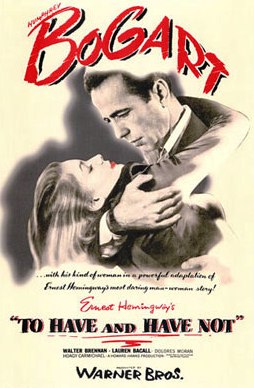
I had high hopes for To Have and Have Not.

The 1944 film was based on a Hemingway novel – a mediocre novel, but a Hemingway novel nonetheless – and it was directed by Howard Hawks, the man responsible for classics such as Scarface, The Big Sleep and El Dorado. With William Faulkner contributing to the screenplay and the oft-repeated behind-the-scenes legend that stars Humphrey Bogart and Lauren Bacall fell in love while making this movie, how could the film be anything other than cinematic dynamite, sizzling at the fuse?
Unfortunately, in spite of all of the aforementioned big names, To Have and Have Not fails to deliver in multiple categories – charm being perhaps the most important one. Essentially, what we get is a confusing kind of best-effort from a lot of creative people who decided to remake another Bogart film that truly is a classic – Casablanca.

To Have and Have Not’s failure begins – but by no means ends – with its curious script, in which the novel’s tale about a desperate man who turns to gunrunning is completely jettisoned in favor of an incomprehensible intrigue revolving around a handful of Frenchmen resisting the whims of Vichy France on the Island of Martinique. As if this obvious plot point were not enough to ram home the resemblance the studio was shooing for, many of the film’s set pieces take place inside a bar that if you squint your eyes could almost be as effortlessly cool as “Rick’s CafĂ©.” When everybody isn’t drinking and smoking and looking for the strangely absent roulette wheel, there is a great deal of official-sounding talk about having the proper papers and about fighting for the “cause.” And occasionally, a German stool pigeon shows up – played rather deftly by Dan Seymour – and makes trouble for everyone.

It is tough to criticize Bogart for walking and talking like Rick Blaine, even though he does this throughout To Have and Have Not. Having seen Bogart as Harry Morgan in this film, Bogart as Blaine in Casablanca and Bogart as Philip Marlowe in The Big Sleep in a span of about two weeks, I would be lying if I could point to any difference in his performances. Bogart always plays himself, and I am okay with that. He has an incredible on-screen presence and the fact his devil-may-care coolness has never been equaled is more than enough to forgive him whatever other faults he may have as a performer.

Bacall’s performance in To Have and Have Not is more difficult to classify.

Certainly, she does enough here to justify the superstardom that would eventually follow, and she more than matches Bogart in their scenes – itself no mean feat, considering this was her first film and she was the screen-legend’s junior by more than 20 years. As for the legendary Bogart/Bacall chemistry, it is clear the two get along in this picture, but I am not sure anything extraordinary happens.
My failure to find the duo’s fabled chemistry could also have something to do with the obviousness with which Bacall is parachuted into this film. That is, unlike Ingrid Bergman’s character in Casablanca, Bacall’s really has no reason for sauntering into Bogart’s watering-hole in To Have and Have Not. Furthermore, once she has landed in the middle of the film’s opaque plot, the writers keep her there without ever really inventing a compelling reason for doing so.

That everyone else also seems to be going through the motions a little too well is very evident at the film’s conclusion, when there is no great climax to the plot’s muted conflict, no great sacrifice demanded of its hero and no promise that anyone in this fictional world is any different from having survived the depicted events. In other words, it does not end with the triumphal flare and tragic wonderfulness of Casablanca. That wouldn’t be a problem, except Casablanca is the film everyone here is supposed to be trying to ape.

Of course, the reasonableness of trying to reproduce the Casablanca magic just two years after its release is the silent, unanswered question that looms over the entirety of To Have and Have Not. I cannot fathom why anyone ever attempted such a fool’s errand, and if this film teaches us anything, it is that you cannot remake a classic – no matter how gifted a troop of talent you assemble.