Showing posts with label Seafaring. Show all posts

Sunday, August 4, 2013

Revenge without Responsibility

First, a confession.

I grew up watching Disney’s 1954 film 20,000 Leagues Under the Sea on a video cassette – do people still remember those? – and I must have replayed the film a couple of dozen times. I was, in other words, something of a fan, though it would take me years to realize I had a proclivity to drift toward sea stories and even longer to realize why this was. (It is because they are, as one critic writing about Patrick O’Brian’s series of novels wrote, likely the only genre in which all of the great themes – man vs. man, man vs. himself and man vs. nature – can occur in one story).


Returning to old ground smacks of nostalgia, and more times than not, the journeys end very different than we imagine when we begin them. I have wanted to watch 20,000 Leagues again for years, but I never seemed to get around to it, and part of my distraction, I suppose, was intentional, in that I was in no great hurry to ruin my memories of what up until that point could be a considered a “childhood favorite” of mine.  Is there not some part of us all that wants the integrity of Santa Claus to remain just as it was before we learned the truth and it fled forever? Fortunately, in this case, the cinematic return ended well: 20,000 Leagues remains a solid sea story, one with interesting characters and more than enough ideas to keep an adult entertained.

As for the special effects?

Well, they have not aged poorly. Indeed, I suspect they have aged much better than many of the insipid, CGI-infused creations we are currently subjected to at the theater. I suspect the effects matter less in something like 20,000 Leagues because the characters matters more, and when Kirk Douglas faces off against the giant squid in the sequence forever enshrined in the Disney theme park ride, we care about him and James Mason’s Captain Nemo a great deal more than do about whether the tentacles of the beast flail realistically enough. If you want a touchstone for a comparison to see what I mean, try and recall how unimpressive the similar sequence is in the Johnny Depp Pirates series. One cannot imagine that scene, that film – indeed, that film series – firing the imaginations of young children five years from now, let alone sixty years from now, as the above-mentioned depiction from Jules Verne’s timeless novel has.


However, the fiber that holds this film together all these year later is the matter in between the sea monsters and underwater sequences. As I already suggested, the performances of Douglas and Mason, to say nothing of Peter Lorre and the lesser known Peter Lukas, are something to behold. Between the four, the audience is afforded glimpses at human archetypes as the group wrestles with the mysterious Captain Nemo’s competing shades of subtle brilliance and melancholic revenge.

The backstory, which should be familiar to all, is Nemo’s rage towards unnamed nations that ship arms that fueled what passes in the film as a loose kind of economic imperialisms. The details of Nemo’s angst are never made fully clear, but this lack of filling in the blank works in the film’s favor. Free from political commentary, Nemo and his lust for revenge that take center stage, while Douglas, Lorre and Lukas look on and puzzle over what to make of it with their very different levels of intelligence, personalities and ideological inclinations (or lack thereof in the case of Lorre – a coward – and Douglas – a brave but politically unconcerned sailor).


At odds with the violence, Nemo and his crew live in almost complete harmony with sea, taking what they want from it in food and supplies, as they cruise across the world – largely under the waves – in Nemo’s own monster, a metal-clad submarine that is virtually unstoppable in the age of wood and sail. The Nautilus only rises to replenish supplies or whenever it must become the embodiment of Nemo’s rage and plunge headlong into a ship, sinking it by opening up its timbers upon contact. There is something demented and childish in this. One man’s nightmare of revenge is visited on the world through an instrument he uses to literal bash against things until they are no more. How different is this than the senseless child, who full of anger, will repeatedly hit his head against something? Not much.

Like many Mason characters, Nemo (Latin for “no one”) is classy and cultured. He has an extensive library, an impressive mind and a first-rate accent. But as the movie makes plain, his revenge ensnares the guilty and the innocent alike. The ship Nemo sinks with Douglas and company aboard was sent to discover Nemo and stop the killing, not carry war materials to abuse an unnamed population, and it is unlikely that Lorre and Lukas are the first civilians blameless in the wars Nemo believes he is stopping that end up in the water because the Nautilus encountered their vessel and sunk it with no remorse for the bodies left in the water.


What we have here then is revenge without responsibility, an oddity when one considers Nemo is railing against men who fund and arm wars without accepting responsibility the havoc and death they cause. It is possible, I suppose, that Nemo began nobly, but that his rage eventually consumed him and he ceased to be selective about whom he lashed out against in his submarine. In the Verne novel, Nemo is far more sinister and obviously mad. That he is not in the film is likely on account that this is, above all else, an adventure picture for children and sheer amounts of dastardliness can only be depicted so much.     
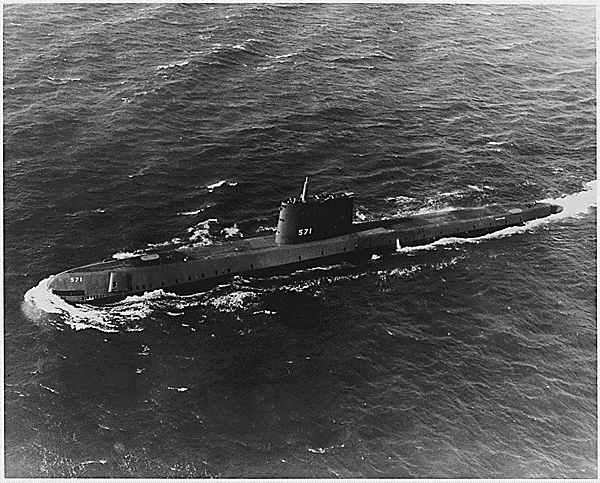

The comparisons to Ahab here are easy to reach for, but viewing it from our perch some 60 odd years later I propose that we can indulge in the reality that this film appeared amid the height of the Cold War, an age in which atomic submarines began plumbing the depths of the world’s oceans, playing a game of cat-and-mouse not unlike what is on-screen here. Indeed, within a few years of the film’s release, those same submarines grew larger and started carrying a cargo of nuclear weapons that are far deadlier than anything Nemo imagined and real submarine named U.S.S. Nautilus sailed under the North Pole to prove a submarine could slip close enough to annihilate the Soviet Union if called upon to do so. The world, as they say, was never the same.


We glimpse some of this in Nemo’s decision to scuttle his submarine at the end of the picture. Nemo does so because humanity is not yet ready for the technology he unleashed in his machine (it is suggested his submarine is in fact nuclear-powered). This, the film’s almost solitary political pronouncement, could not have been lost on discerning audiences in the cold winter of the mid-1950s. What we are to make of this today, I am not sure. That the verdict on humanity is still out? That such machines should be only in the hands of capable people? Or that responsibility has shown itself, in some form, in the fact that we have not succumb to baser emotions and annihilated one another, even though we now have the means to do so? I suppose we each all have our answers, but at the same time I am fairly confident that we can all agree with one of the film’s other messages: That power in the hands of the irresponsible tends to destroy everything in its path – and then, eventually, the irresponsible destroy themselves.

Monday, January 10, 2011

The Complicated Bounty of Mythmaking

We never seem to tire of stories about the 18th century ship known as the Bounty.

Sent in 1789 to Tahiti to transplant the breadfruit tree to the Caribbean, the crew mutinied against Captain William Bligh three weeks into the return journey and set him and 18 others adrift in 23-foot boat in the middle of the Pacific Ocean. The Bounty and most of its crew then landed at Pitcairn Island and lived out their natural lives there. Bligh made an incredible 41-day journey to Timor and then returned to England. He went on to fight with Nelson, survived another mutiny in Australia and died with pomp and circumstance as an admiral.


A man driven by professionalism and duty, Bligh would probably recoil if someone suggested during his lifetime that hundreds of years later his name would be synonymous with sadism and tyranny, and if the actual history of the Bounty’s mutiny is anything to go by, he would be within his rights to feel unjustly treated by the cabal of poets, authors and screenwriters who have chosen to elevate the plight of the ship’s mutineers at his expense. But dramatically speaking, Bligh never had a chance: Artists tend not to extol the virtues of authority and argue for its legitimacy.

Caroline Alexander wrote an excellent book dispelling many of the erroneous Bounty myths that have come down to us, including the fiction that Bligh was a heartless dictator, but the splash her lively and detailed scholarship made is nowhere near powerful enough to undo hundreds of years of ripe retellings and exaggerations. Sea stories are typically better when they are not true, but on this occasion, as anyone who has read her books knows, straying from the facts has coarsened the tale and made it less remarkable. Bligh’s open boat voyage is typically given short shrift, as is the incredible tale of the British ship that returned to Tahiti to round up some of the mutineers. What we are left with, then, is a rather exotic tale of good and evil, of one man’s tyranny (Bligh) and another man’s political descent into open rebellion (Fletcher Christian, Bligh’s 2nd in command). There is, at this point, a healthy body of literature repeating this dichotomy and at least five films that do the same.

Among this impressive corpus is the curiously uneven 1962 film starring Trevor Howard as Bligh and Marlon Brando as Christian.
The role seems a natural one for Brando, who at this point in his career is still young and dangerous-looking and full of the kind of combustible energy that worked so well when directors pitted him against some sort of authority – oppressive or otherwise. The only problem here is that Brando is horribly miscast in the Christian role and he fails to deliver most of his lines with anything like the craftsmanship we expect from an actor of his caliber. A great deal of the problem lies in the accent he inexplicably verbalizes. There is a well-known joke in England that the upper classes speak as though they have plums in their mouths. Somebody must have told Brando this, because he spends most of the picture with his head cocked slightly backward, his eyebrows aloft with a kind of bemused arch as he conjures words through his nose.


To make matters worse, both Brando and the script presents Christian as a rich dandy, bored with pretty much everything life has to offer. When he first reports for duty, he is dressed in a preposterous costume and he struts across the deck with two well-heeled strumpets on his arm. At one critical point in the film, he appears in foppish pajamas smoking a pipe befitting a hobbit. At another, he is seen traipsing around the deck sketching while the rest of the men go about the business of sailing a ship halfway round the world.


Pressed by Bligh about his motivation, Christian confesses he serves His Majesty’s navy only because the army was “too dusty” and “one must do something.” Bligh, who is presented as clearly not of this kind of landed gentry, eventually accuses Christian of thinking he is better than everyone else and being incapable of any emotion but contempt, both of which ring true and hardly make Christian the likeable leader of truth and right the film desperately wants us to think he is.

Although it is woefully inaccurate, Howard’s portrayal of Bligh is far more interesting.

In the film, the real Bligh’s foul mouth and puritanical leanings are jettisoned in favor of showing him as the living incarnation of corrupted authority. Command is lonely and personally unsatisfying and the ability to terrorize other men its only reward. Christian accuses Bligh of beating the men because he enjoys it, but as an audience, I am not sure we see any overt sadism. Rather, Bligh beats his men from a misguided sense of duty. “Cruelty with purpose is not cruelty,” he tells Christian, “it’s efficiency.”


This chilling thought, which must run through the warped mind of every dictator who ever plagued his people, is further emboldened by the mistaken notion that the best way to entice men to achievement is through fear and intimidation. The irony, of course, is that Bligh finds the concept of fear so powerful because he himself is driven by it. The scene of Bligh surrounded by breadfruit trees in his cabin, mentally quaking at the thought of any one of them not living to see Jamaica, reveals that the Captain actually fears the Lords of the Admiralty, and that his mistaken notion of leadership is akin to passing this fear down the chain of command to the common hands (blame also works this way in this film, as Bligh never seems prepared to accept that he is ultimately responsible for his ship’s failures).

The catalyst that undoes the unhappy ship’s “efficiencies” is the island of Tahiti, which in every Bounty story is presented as a verdant paradise, full of beautiful and pliant women, plentiful food and, of course, a respite from scrubbing the deck with holystones or going aloft to trim sail. It is difficult for contemporary audiences to imagine what it must have been like to work day after day on a sailing vessel in cramped living conditions with bad food and harsh discipline. It is even harder to imagine what arrival at Tahiti must have been like, for today’s expensive island vacation destination was to the 18th century Englishmen probably akin to landing on the Moon, so different was Pacific tribal nation from everything he had ever known.


The exotic allure of Tahiti’s unusualness is captured quite well in Charles Nordhoff and James Norman Hall’s 1932 novel, but ignored almost entirely in this film. In its place, the complex dichotomy between conscription and freedom is explored more freely, as the sailors, led by a rebellious Richard Harris, begin to think unconsciously – and in crude terms – about their human rights.

There is something paradoxical and naive in the way all Bounty stories depict Tahiti as existing in a state of nature where the cruelty, violence and struggle for food and shelter conveniently do not exist. The trope of the noble savage is nothing new, of course, but I do not think it has ever been used more powerfully than in the Bounty stories, where the Europeans quite literally are entranced by an island culture at the same time they are abusing it and ruefully shaking their heads at its sheer backwardness.

Or maybe I am reading too much into all this? Remarking on how most of the Bounty men – save Bligh, of course – took wives and fathered children on Tahiti, a friend once quipped that the true theme of the Bounty stories is that men will do crazy things for love, which is really just a polite way of stating that men will do crazy things for sex.

Given this undeniable truth, what are we to make of the actual mutiny, then?

In the film, Christian claims he acted for honor. Later, he tries to compel the ship’s company to give up their notion of hiding on an uncharted Pacific island and return to England for the same reason. Given that honor is largely a personal matter, Christian’s role as emancipator seems complicated by these justifications and entreaties. Before he was put over the side, Bligh says “a little show of temper” is really what drove Christian to rebel – a point the novel also alludes to when it contends that Christian simply grew tired of being humiliated in front of the hands by his overbearing Captain.


Establishing Christian’s motivation is all important, because by the end of the film we are supposed to view him as some kind of hero. His protracted death scene, which finally sees Brando fulfill his talent’s promise (even if his speech runs on too long), offers an appeal to principles that attempts to redeem the mutiny on moral grounds. However, it is clear the crewmen do not view the mutiny as such, and indeed seem scornful of Christian and reluctant to endorse his worldview.

Our understanding is further complicated by the fact that the real Fletcher Christian was murdered by other mutineers, a victim of the forces of chaos he unleashed. I am not sure what lesson that leaves us with, but it is something quite different than the film, in which Christian is strangely aloof for a good two hours and then excessively lionized for a few moments before he dies. The uncertainty of anarchy and the inability of the actual mutineers to leave their former prejudices behind when they attempt to setup their own island paradise is precisely why it fails, but this problematic ending is typically untouched in most Bounty re-tellings.

Strictly speaking, Mutiny on the Bounty remains an impressive film. Its monstrous budget, which included a life-size replica of the Bounty and scenes filmed in Tahiti, ensured it is visually one of the most exciting sea-faring epics ever produced. Still, for all its fine craftsmanship, this film fails to capture the power of the actual Bounty story. It is muddled in setup, fumbled in execution and uncertain of its ultimate message, and powerful performances from Howard and Harris cannot mask Brando’s off-key and bewildering turn as Fletcher Christian.

Despite this, people should watch this film for its ambition. They should watch it for what it wants to be, not for what it is.