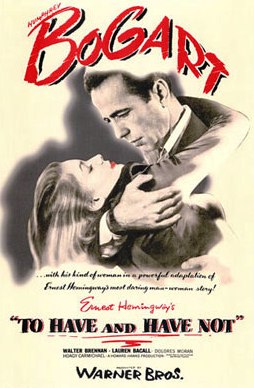
Strange waters these.
I am quite the
Humphrey Bogart devotee, as my profile of him on this site suggests.

And so I find
myself wandering in unfamiliar territory when I make the claim that I do not
believe Bogart works well as Raymond Chandler’s infamous shamus in 1945’s The Big Sleep, a film that also suffers
from far too much subtlety and not enough naked awfulness (more on the latter
below). In most cases, I would defend Hollywood’s by-gone penchant for leaving
the crude unsaid and for suggesting rather than showing, largely because we
have far too much of the opposite these days, but in the case of The Big Sleep, the production code at the
time simply did not allow for the grit and grime and human frailty of Chandler’s
pre-war Los Angeles to appear on-screen.
And Bogart,
painful as it is for me to write, is part of the problem.
Certainly, he
is great in the other film noir detective classic – The Maltese Falcon.

In that film, Bogart
shines as Sam Spade, but that is largely because Sam Spade has no human
weaknesses, is on a mission of righteous revenge. Bogart also essentially plays
him as Bogart. But Phillip Marlow, Chandler’s know-it-all private dick? As a
tremendous fan of a writer I consider much more than a mystery hack, I can
honestly say there is a tragic grandeur to Marlow that Bogart just cannot
capture. Bogart is too sure of himself, too clean and too self-righteous for
Marlow, a man whom Chandler writes as a kind of fallen angel, a once-righteous
being that is now chock full of cynicism to shield himself from more
disappointment, more failure.

Marlow on the
page is a grubby human who makes a grubby living, but he infuses what is an
otherwise parasitic and not-so-honest way of living with a kind of noble
grandeur by adhering to a strict and unspoken code that raises him above his
clients and their short-term interests driven by greed or sex. Bogart, on the
other hand, is noble in The Big Sleep,
but he has none of Marlow’s ugliness, none of his self-awareness about his
character’s ugliness, and consequently, he delivers lines intended to convey
pained self-understanding – no doubt gained through previous unspeakable awful
events – with such deadpan earnestness that the dialogue comes across a series
of clever quips instead of moments of carefully crafted, naked confession.
Perhaps this failure
has to do with the Howard Hawks’ impressive but flawed production.
Faithfulness
is often a virtue, but in this case, the film tries to follow so many of the
novel’s permutations – of which there are many – that the result is dizzyingly
confusing onscreen (it all works much better on the page). Indeed, two endings
of the film were cut, both of which are available on the DVD, because audiences
in 1945 were uncertain exactly what the hell happened in Hawks’ first attempt
at a resolution. So he tried again. I could follow events well enough, but then
I have read the novel and had that as a primer. Woe to the filmgoer who
approaches the story here cold.
This is not to
say the good guys are not obvious and the bad even more so.

Lauren Bacall
simmers here in one of her three onscreen appearances with Bogart as the more
responsible, if somewhat still less than honest, daughter of Bogart’s client.
Bacall arches her eyebrows in all the right places and she absolutely purrs all
the right lines at just the right moment with just the right amount of
licentiousness.
Martha Vickers’ sucking her thumb and batting her eyes as she attempts to lure men to their doom or find a new thrill is much more disturbing and much closer to the mark laid down by the novel. Her portrayal of the little girl all grown up in all the wrong ways is both frightening and positively scandalous. And why the filmmakers went this dark in this one portion of the movie and remained vanilla elsewhere mystifies. She is, at one point, quite clearly drugged, raped and photographed for blackmail purposes. As if this is not enough, Vickers makes it clear her character actually enjoyed the defilement.
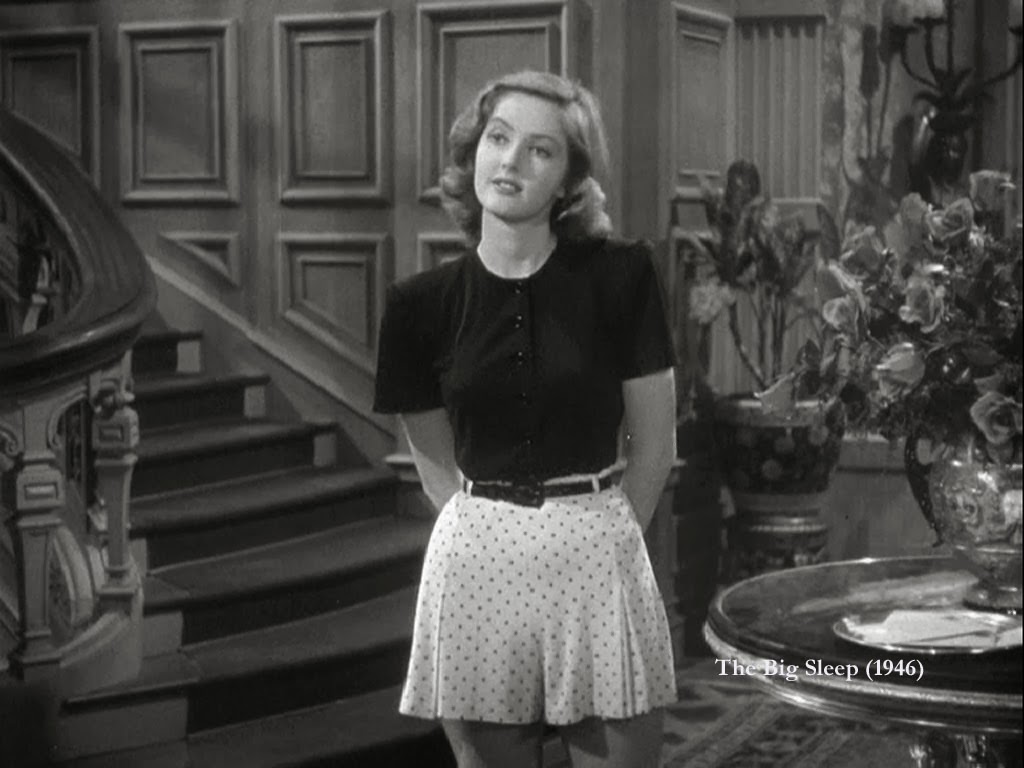
The relatives
around Vickers, Bacall included, is far cleaner than Chandler’s dark vision of
a noble family that has been dragged down by the ugliness of their environment
and the awfulness of their individual obsessions. Part of this, I suspect,
stems from the filmmakers needing to make Bacall a legitimate love interest for
Bogart. Hence, she cannot be that bad
and must have some redeemable qualities, despite being dangerous and very
obviously a femme fatale of sorts. The problem is this waters down Vickers performance
– to say nothing of the rest of the rogues gallery on display here – and makes
her actions appear almost alien. Context is important and the disjointedness apparent
in the film goes well beyond its uneven handling of its characters. For
example, it is even more difficult for the audience to find a context for the
plot’s sheer awfulness, given that the L.A. we see here looks like what it is:
The L.A. of glittering movie sets. Chandler’s vision of the city is something
more sinister, and is perhaps lost to history after a fashion. That is, Los
Angeles now has 70 years of crime and riots to chip away at its glamour and
nobody today would be shocked that the events in The Big Sleep could occur there. But Chandler was writing about
pre-War California, when it was the land of bright promise and sunshine and
people migrated there for the climate and new job opportunities – not to fester
in an overregulated, traffic-sodden economy built on an odd combination of
Hollywood, the music industry and street crime. Like a more contemporary
director, David Lynch, Chandler was peeling back the normalness – to say
nothing of the downright positivism that sunny California built itself selling
– and showing his audience that private eyes like Marlow needed to exist in the
otherwise beautiful climate out West, because people were secretly running
drugs, having covert affairs and constantly trying to rob their fellow
Californians.

Amongst this,
Marlow navigates the city’s hellish underbelly in an almost monastic way. Sure,
he smokes constantly, is probably an alcoholic and his way of making a living
could be considered somewhat dubious, but given the characters around him, the
ones his job forces him to deal with, he is simple, pure and perhaps even holy.
Indeed, Marlow never overcharges, never switches side or falls for a femme
fatale, the latter of which the movie ignores (there has to be a love interest,
right?). Thus, The Big Sleep’s biggest disappointment is that this Marlow is
not present on the screen. Bogart’s Marlow is not better than his fellow
characters, he is simply smarter and less driven to vice. I do not think
Chandler is interested in this kind of relativistic judgment. Hard and ugly judgments
are more his thing. And make no mistake, this is not an ugly film. The times
just would not allow it and the actors, in most cases, just did not have that
kind of depravity in them.