Monday, November 11, 2013

Not Dark Enough

Strange waters these.

I am quite the Humphrey Bogart devotee, as my profile of him on this site suggests.


And so I find myself wandering in unfamiliar territory when I make the claim that I do not believe Bogart works well as Raymond Chandler’s infamous shamus in 1945’s The Big Sleep, a film that also suffers from far too much subtlety and not enough naked awfulness (more on the latter below). In most cases, I would defend Hollywood’s by-gone penchant for leaving the crude unsaid and for suggesting rather than showing, largely because we have far too much of the opposite these days, but in the case of The Big Sleep, the production code at the time simply did not allow for the grit and grime and human frailty of Chandler’s pre-war Los Angeles to appear on-screen.

And Bogart, painful as it is for me to write, is part of the problem.

Certainly, he is great in the other film noir detective classic – The Maltese Falcon.


In that film, Bogart shines as Sam Spade, but that is largely because Sam Spade has no human weaknesses, is on a mission of righteous revenge. Bogart also essentially plays him as Bogart. But Phillip Marlow, Chandler’s know-it-all private dick? As a tremendous fan of a writer I consider much more than a mystery hack, I can honestly say there is a tragic grandeur to Marlow that Bogart just cannot capture. Bogart is too sure of himself, too clean and too self-righteous for Marlow, a man whom Chandler writes as a kind of fallen angel, a once-righteous being that is now chock full of cynicism to shield himself from more disappointment, more failure.


Marlow on the page is a grubby human who makes a grubby living, but he infuses what is an otherwise parasitic and not-so-honest way of living with a kind of noble grandeur by adhering to a strict and unspoken code that raises him above his clients and their short-term interests driven by greed or sex. Bogart, on the other hand, is noble in The Big Sleep, but he has none of Marlow’s ugliness, none of his self-awareness about his character’s ugliness, and consequently, he delivers lines intended to convey pained self-understanding – no doubt gained through previous unspeakable awful events – with such deadpan earnestness that the dialogue comes across a series of clever quips instead of moments of carefully crafted, naked confession.

Perhaps this failure has to do with the Howard Hawks’ impressive but flawed production.

Faithfulness is often a virtue, but in this case, the film tries to follow so many of the novel’s permutations – of which there are many – that the result is dizzyingly confusing onscreen (it all works much better on the page). Indeed, two endings of the film were cut, both of which are available on the DVD, because audiences in 1945 were uncertain exactly what the hell happened in Hawks’ first attempt at a resolution. So he tried again. I could follow events well enough, but then I have read the novel and had that as a primer. Woe to the filmgoer who approaches the story here cold.

This is not to say the good guys are not obvious and the bad even more so.


Lauren Bacall simmers here in one of her three onscreen appearances with Bogart as the more responsible, if somewhat still less than honest, daughter of Bogart’s client. Bacall arches her eyebrows in all the right places and she absolutely purrs all the right lines at just the right moment with just the right amount of licentiousness.

Martha Vickers’ sucking her thumb and batting her eyes as she attempts to lure men to their doom or find a new thrill is much more disturbing and much closer to the mark laid down by the novel. Her portrayal of the little girl all grown up in all the wrong ways is both frightening and positively scandalous. And why the filmmakers went this dark in this one portion of the movie and remained vanilla elsewhere mystifies. She is, at one point, quite clearly drugged, raped and photographed for blackmail purposes. As if this is not enough, Vickers makes it clear her character actually enjoyed the defilement.


The relatives around Vickers, Bacall included, is far cleaner than Chandler’s dark vision of a noble family that has been dragged down by the ugliness of their environment and the awfulness of their individual obsessions. Part of this, I suspect, stems from the filmmakers needing to make Bacall a legitimate love interest for Bogart. Hence, she cannot be that bad and must have some redeemable qualities, despite being dangerous and very obviously a femme fatale of sorts. The problem is this waters down Vickers performance – to say nothing of the rest of the rogues gallery on display here – and makes her actions appear almost alien. Context is important and the disjointedness apparent in the film goes well beyond its uneven handling of its characters. For example, it is even more difficult for the audience to find a context for the plot’s sheer awfulness, given that the L.A. we see here looks like what it is: The L.A. of glittering movie sets. Chandler’s vision of the city is something more sinister, and is perhaps lost to history after a fashion. That is, Los Angeles now has 70 years of crime and riots to chip away at its glamour and nobody today would be shocked that the events in The Big Sleep could occur there. But Chandler was writing about pre-War California, when it was the land of bright promise and sunshine and people migrated there for the climate and new job opportunities – not to fester in an overregulated, traffic-sodden economy built on an odd combination of Hollywood, the music industry and street crime. Like a more contemporary director, David Lynch, Chandler was peeling back the normalness – to say nothing of the downright positivism that sunny California built itself selling – and showing his audience that private eyes like Marlow needed to exist in the otherwise beautiful climate out West, because people were secretly running drugs, having covert affairs and constantly trying to rob their fellow Californians.


Amongst this, Marlow navigates the city’s hellish underbelly in an almost monastic way. Sure, he smokes constantly, is probably an alcoholic and his way of making a living could be considered somewhat dubious, but given the characters around him, the ones his job forces him to deal with, he is simple, pure and perhaps even holy. Indeed, Marlow never overcharges, never switches side or falls for a femme fatale, the latter of which the movie ignores (there has to be a love interest, right?). Thus, The Big Sleep’s biggest disappointment is that this Marlow is not present on the screen. Bogart’s Marlow is not better than his fellow characters, he is simply smarter and less driven to vice. I do not think Chandler is interested in this kind of relativistic judgment. Hard and ugly judgments are more his thing. And make no mistake, this is not an ugly film. The times just would not allow it and the actors, in most cases, just did not have that kind of depravity in them.

Sunday, August 4, 2013

Revenge without Responsibility

First, a confession.

I grew up watching Disney’s 1954 film 20,000 Leagues Under the Sea on a video cassette – do people still remember those? – and I must have replayed the film a couple of dozen times. I was, in other words, something of a fan, though it would take me years to realize I had a proclivity to drift toward sea stories and even longer to realize why this was. (It is because they are, as one critic writing about Patrick O’Brian’s series of novels wrote, likely the only genre in which all of the great themes – man vs. man, man vs. himself and man vs. nature – can occur in one story).


Returning to old ground smacks of nostalgia, and more times than not, the journeys end very different than we imagine when we begin them. I have wanted to watch 20,000 Leagues again for years, but I never seemed to get around to it, and part of my distraction, I suppose, was intentional, in that I was in no great hurry to ruin my memories of what up until that point could be a considered a “childhood favorite” of mine.  Is there not some part of us all that wants the integrity of Santa Claus to remain just as it was before we learned the truth and it fled forever? Fortunately, in this case, the cinematic return ended well: 20,000 Leagues remains a solid sea story, one with interesting characters and more than enough ideas to keep an adult entertained.

As for the special effects?

Well, they have not aged poorly. Indeed, I suspect they have aged much better than many of the insipid, CGI-infused creations we are currently subjected to at the theater. I suspect the effects matter less in something like 20,000 Leagues because the characters matters more, and when Kirk Douglas faces off against the giant squid in the sequence forever enshrined in the Disney theme park ride, we care about him and James Mason’s Captain Nemo a great deal more than do about whether the tentacles of the beast flail realistically enough. If you want a touchstone for a comparison to see what I mean, try and recall how unimpressive the similar sequence is in the Johnny Depp Pirates series. One cannot imagine that scene, that film – indeed, that film series – firing the imaginations of young children five years from now, let alone sixty years from now, as the above-mentioned depiction from Jules Verne’s timeless novel has.


However, the fiber that holds this film together all these year later is the matter in between the sea monsters and underwater sequences. As I already suggested, the performances of Douglas and Mason, to say nothing of Peter Lorre and the lesser known Peter Lukas, are something to behold. Between the four, the audience is afforded glimpses at human archetypes as the group wrestles with the mysterious Captain Nemo’s competing shades of subtle brilliance and melancholic revenge.

The backstory, which should be familiar to all, is Nemo’s rage towards unnamed nations that ship arms that fueled what passes in the film as a loose kind of economic imperialisms. The details of Nemo’s angst are never made fully clear, but this lack of filling in the blank works in the film’s favor. Free from political commentary, Nemo and his lust for revenge that take center stage, while Douglas, Lorre and Lukas look on and puzzle over what to make of it with their very different levels of intelligence, personalities and ideological inclinations (or lack thereof in the case of Lorre – a coward – and Douglas – a brave but politically unconcerned sailor).


At odds with the violence, Nemo and his crew live in almost complete harmony with sea, taking what they want from it in food and supplies, as they cruise across the world – largely under the waves – in Nemo’s own monster, a metal-clad submarine that is virtually unstoppable in the age of wood and sail. The Nautilus only rises to replenish supplies or whenever it must become the embodiment of Nemo’s rage and plunge headlong into a ship, sinking it by opening up its timbers upon contact. There is something demented and childish in this. One man’s nightmare of revenge is visited on the world through an instrument he uses to literal bash against things until they are no more. How different is this than the senseless child, who full of anger, will repeatedly hit his head against something? Not much.

Like many Mason characters, Nemo (Latin for “no one”) is classy and cultured. He has an extensive library, an impressive mind and a first-rate accent. But as the movie makes plain, his revenge ensnares the guilty and the innocent alike. The ship Nemo sinks with Douglas and company aboard was sent to discover Nemo and stop the killing, not carry war materials to abuse an unnamed population, and it is unlikely that Lorre and Lukas are the first civilians blameless in the wars Nemo believes he is stopping that end up in the water because the Nautilus encountered their vessel and sunk it with no remorse for the bodies left in the water.


What we have here then is revenge without responsibility, an oddity when one considers Nemo is railing against men who fund and arm wars without accepting responsibility the havoc and death they cause. It is possible, I suppose, that Nemo began nobly, but that his rage eventually consumed him and he ceased to be selective about whom he lashed out against in his submarine. In the Verne novel, Nemo is far more sinister and obviously mad. That he is not in the film is likely on account that this is, above all else, an adventure picture for children and sheer amounts of dastardliness can only be depicted so much.     


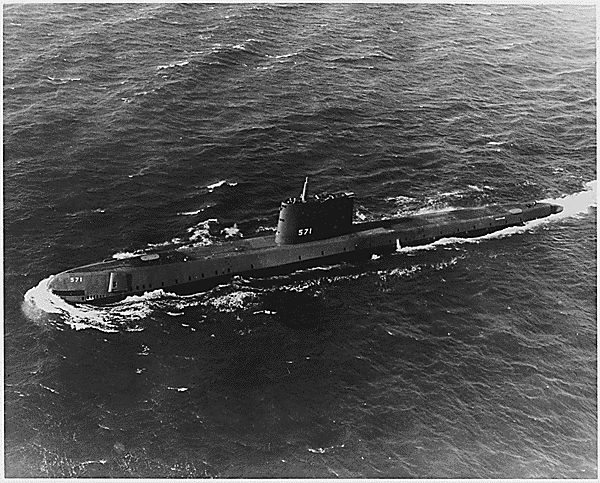
The comparisons to Ahab here are easy to reach for, but viewing it from our perch some 60 odd years later I propose that we can indulge in the reality that this film appeared amid the height of the Cold War, an age in which atomic submarines began plumbing the depths of the world’s oceans, playing a game of cat-and-mouse not unlike what is on-screen here. Indeed, within a few years of the film’s release, those same submarines grew larger and started carrying a cargo of nuclear weapons that are far deadlier than anything Nemo imagined and real submarine named U.S.S. Nautilus sailed under the North Pole to prove a submarine could slip close enough to annihilate the Soviet Union if called upon to do so. The world, as they say, was never the same.


We glimpse some of this in Nemo’s decision to scuttle his submarine at the end of the picture. Nemo does so because humanity is not yet ready for the technology he unleashed in his machine (it is suggested his submarine is in fact nuclear-powered). This, the film’s almost solitary political pronouncement, could not have been lost on discerning audiences in the cold winter of the mid-1950s. What we are to make of this today, I am not sure. That the verdict on humanity is still out? That such machines should be only in the hands of capable people? Or that responsibility has shown itself, in some form, in the fact that we have not succumb to baser emotions and annihilated one another, even though we now have the means to do so? I suppose we each all have our answers, but at the same time I am fairly confident that we can all agree with one of the film’s other messages: That power in the hands of the irresponsible tends to destroy everything in its path – and then, eventually, the irresponsible destroy themselves.

Tuesday, July 10, 2012

Truly Exceptional

In honor of America’s birthday last week, I have cobbled together a mini-tribute of three film classics that I believe say something about the nature of American Exceptionalism. Not much in vogue these days, the concept of the United States as a “city on a hill,” driven by very different impulse than its European brethren was first suggested by John Winthrop as he and his pilgrims bobbed off the coast of what would become the Massachusetts Bay Colony. The phrase itself would come later from Alexis de Tocqueville, who described the United States as "exceptional" in 1831. As I have already suggested, it is not terribly politic to talk in such terms anymore, but the idea itself, and indeed the smaller, component ideas that makeup the larger concept, are alive and well in classic film ... if you know where to look.


High Noon (1952)

The quintessential “new sheriff in town” film, only Gary Cooper is the regular sheriff (not the new one), and in this case, his refusal to kowtow to a gang of bandits and leave town is what drives home the film’s larger points about what good men do – or at least should do – when they encounter evil. The metaphor here is not hard to find, and in retrospect, it can be stretched in a number of ways it probably was not intended, but which in my opinion only make the film greater and a more powerful presentation of American values. When threatened with the return of an infamous gang Cooper once locked up, the townspeople refuse to form a posse with him and face down the brutes. Instead, they want Cooper to leave town, thinking that with him gone, they can make a separate peace with the bullies through talk and concessions. Cooper knows otherwise and says as much, but nobody listens. So he decides to stay and take on the gang himself.  The essence of the “strong, silent type” that is in much less supply these days, he faces the gang for the sake of honor, but more than that, he does it for the sake of order, realizing that laws do not mean anything if they are enforced only when it is easy and convenient. What is that? A Cold War parable you say? You bet. Cooper is America, standing up to the Soviet Union and all the tin pot dictators of the world, while the rest of the community of nations prevaricate and argue for understanding, deal-cutting and anything other than confrontation (hey, it is safer, right?). The scene where Cooper confronts the townspeople in Church and they blame him for the fact that bad people want to do terrible things is particular poignant and has obvious real world corollaries. In the end, America (Cooper) stands on its own, doing the ugly duty that must be done, because no one else has the stomach for it.


Davy Crockett (1955)

A film impossible for red-blooded youngsters to dislike, this beloved Disney classic might present a surface-level view of history, but its enduring personification of America’s frontier spirit more than matches this undertaking's deliberate shortcomings. Fess Parker became a boyhood legend, thanks to this movie and its accompanying television program, and 1950s America briefly went coon-skin cap crazy, as boys everywhere took to the woods with wooden rifles to domesticate their own stretch of wilderness in suburban America. At its heart an adventure film, Parker nonetheless manages to embody the boldness that drove America west. At the same time, Parker’s Crockett moves from a scout who helped Andrew Jackson hunt down rogue Indians to a Congressman who passionately defends Indian rights and excoriates the increasingly ridiculous treaties his former commander foists upon the defeated tribes. The more cynical might call this revisionism, but the real Crockett did indeed break with Jackson and he essentially moved to Texas in response to his disgust with American policy. He famously died at the Alamo, defending the defenseless in spite of incredibly long odds. Accordingly, Crockett embodies the individual at war with federalism, and as such, is something of a Jeffersonian idealist-come-folk hero.


The Right Stuff (1983)

One of my favorite films of all-time, this part-Western, part fictionalized documentary captures not only the essence of American can-do entrepreneurship, but also something profound about the very nature of what it means to be human and to seek achievement for achievement’s sake. Ego plays a great role in both, and there is plenty in this film, in terms of America’s Mercury Astronauts, six of whom eventually blasted into space during the early 1960s in the now-defunct but once much remarked upon space race against the Soviets. Each of the astronauts is a competitive, egoist but each also serves something greater. The reasons American went to space are complex, but the results are not. Leaving the planet and exploring the near solar-system is a historic achievement not just for the nation but for all mankind, a point this film captures in between its depiction of patriotism and shared-sacrifice. However, at an even deeper, more primal level, we have the story of Chuck Yeager, the man who was not an astronaut. Yeager's incredible spirit, his unquenchable desire to go faster or higher is the brutal embodiment of the basic impulse that drives all human endeavors, and I cannot think of another film that captures this quite so well. Meanwhile, as a nation, America achieves as a whole in this film because it believes it is great and that it should achieve. If that's not exceptionalism, I don't know what is...   

Monday, July 2, 2012

The Unbreakable Shell


John Wayne does three things well.

He talks with a languid toughness that manages to sound both intimidating and wise at the same time and whenever he struts across the screen as a soldier or cowboy he comes across as completely legitimate, despite the painful obviousness in many of his performances.


In 1949’s Sands of Iwo Jima, Wayne puts his best boot forward – and collected an Oscar nomination in the process – when he offers up equal doses of stoicism and sympathy in his now-legendary role as the no-nonsense Marine Sergeant Stryker. It is not an exaggeration to say that the very stereotype of the hard-as-nails drill instructor originates with Wayne and this performance. It is also not an exaggeration to assert Wayne being Wayne in this film is precisely what saves an effort that otherwise would be a profound piece of propaganda celebrating the legend of the Marine Corps.

Because as I said, this is not altogether incredible stuff.


There is a kind of paint-by-numbers with these World War Two epics: The platoon or company is always the center of our attention and it is typically comprised of souls with immediately identifiable accents and at least one personality trait that enables the viewer to remember something unique about that character when he is spotted among the rest of the cast. Part of this is economy, because nobody needs a film with a dozen developed characters, and part of it is filmmakers giving the audience what they expect from the genre (see Saving Private Ryan). Sands of Iwo Jima may be decades old and made within living memory of the actual event, but quite a lot of World War Two films had already appeared by 1949, many of them with Wayne in them, and Hollywood knew what people wanted. More complicated war films, with less obvious tracks, would not come until America began to grapple with how to depict the Vietnam conflict on the screen.


In the case of this film, the American triumph on the tiny island of Iwo Jima signified by the iconic flag-raising ceremony on the summit of Mt. Suribachi was known to virtually every American. The photograph, taken by Joe Rosenthal, had not only graced magazine covers and posters, it had also been used extensively as propaganda piece to raise war bonds (see Flags of My Father). The decision to graft a challenging, if somewhat one-dimensional and episodic plot, on top of a film building to an inevitable event therefore deserves some credit. Stryker could have been more boorish and more boring, and in the hands of a lesser actor he might have been.


Wayne makes him believable and he does not with his bark but with the pained scowl he gets whenever he is confronted by another’s failure to perform or on the occasions when the awfulness of failure attempts to impose itself on his life and the fate of his men. There is a telling scene when Wayne encounters a baby belonging to Julie Bishop after a brief romance in her home. The father is gone, either dead or disinterested, and Wayne is painfully reminded of his own estrangement from his child, and haunted by the possibility that he too may one day leave a woman without a man and a child without a father, should he fall combat.

The scene plays well on Wayne’s running confrontation with John Agar, the arrogant, college-educated son of an officer under whom Wayne served. Agar is the smart-aleck recruit who presents his sergeant with a problem. This would feel stale and prosaic were the father/son motif not the foundation of the turmoil. Wayne watched an officer he loved as a father die, and now the son of that officer is under his care. What is he to do? The answer is make certain the son is ready.


On the American side, the battle of Iwo Jim claimed upwards of 6,000 men and 19,000 casualties, including the lives of most of the men in the famous flag-raising photograph. All but 200 or so of the 20,000 Japanese soldiers on the island died in combat. The latter of the two statistics speaks to what manner of battle the American Marine faced on the island – the enemy, almost literally, was willing to fight to the last man, and nearly did so. America's triumph should be viewed in martial terms that take into account those horrific numbers, but also in the more human tones painted in this film. When Wayne, rather inevitably, falls, his men find a letter on him addressed to his estranged son, saying all the things he wanted to say but could not find the strength to do so while he was alive. It is a cliched moment perhaps, but it still makes the audience feel nonetheless. Here is a tireless warrior, a man among men who trained other men to do great things. And here, laid bare, in a letter he knew could only be posted after he died, is his soul. He was unbreakable as a Marine, but even Marines are people, too.

Monday, April 30, 2012

The Greatest Little Steamboat in the World

It does not get much better than this ... for classic films fans.

The African Queen, the dingy, rundown hooting and smoke-spouting little boat from the 1951 classic starring Humphrey Bogart and Katharine Hepburn has been refurbished and put back on the water -- where it belongs. One wonders who the audience will be ... or not so much. After all, Suzanne and Lance Holmquist, the couple who found and refurbished the boat do live in Florida, a location likely to attract an older, more appreciative crowd for what is surely an iconic piece of film history and Americana. Found in a Florida marina (see this news story), the boat looks better than ever and hopefully has a few more memories left to make... 

The "African Queen" is a 100-year-old steam boat famed for its role in the 1951 movie of the same name.


See also my review of the film.


Monday, December 5, 2011

The End of Something?

Hollywood’s fascination with the ancient world makes cinematic sense.

Films are comprised of a great many elements, but above all else, they are visual journeys to a proscribed reality representing a time and place different from our own. Even a contemporary film about contemporary times is artificial in the sense that any narrative structure, by definition, is a representation of reality – not reality itself. Along these lines, it is not surprising filmmakers love costumes and settings that allow them to dabble in world-making, and if one is going to whisk the audience away to somewhere else, why not some other time? But even these points cannot truly account for the spate of sword and sandal films that erupted in the wake of D. W. Griffth’s Intolerance and continued to land on the screen for almost 60-plus years (longer if we include Ridley Scott’s Gladiator and HBO’s Rome). 

Ancient Babylon, from Intolerance.
What else is at work, I suspect, is an attraction to grandeur and momentousness, both of which are tough to spot in one’s own contemporary existence, where and when we tend to remain unimpressed with ourselves – or at the very least, accustomed to our own achievements and challenges. Thus, chariot races become infinitely more visually compelling than moon-landings.


Griffith called his aforementioned effort “colossal spectacle,” and the same description certainly applies to 1964’s The Fall of a Roman Empire, a film that attempts in about three hours to surmise what Edward Gibbon chronicled in several volumes of words. And while it is true this film fails to capture the scope and notoriety of the collapse of one of history’s greatest political systems, it must also be said director Anthony Mann’s attempt sputters along in a rather magnificent fashion. All $20 million of the budget is clearly visible in the picture’s astounding costumes and sets and there are extras galore in the battle scenes. Whatever else it succeeds or fails to achieve, one cannot argue the filmmakers here failed to pay enough time and attention to all things that look, feel or smell Roman.


The opening scenes in the wilds of Germania are particularly well done. Indeed, anyone who smitten with the supposed incredibleness of CGI-animation should return to this film and these scenes and gander at the Roman Fort, perched on the edge of the Empire. Most of the set was probably created through a combination of mat-paintings, miniatures and balsa wood, but it looks stunning on film when the vassals of Marcus Aurelius parade in front of him to pay homage. The rest of the film is equally impressive, too. I read where a total of 55-acres of outdoor sets were constructed, and frankly, I will take this passé extravagance over the computer-spun realities inflicted on us today. 

Even more impressive is how this film, which is openly bent on grandness, also takes the time to get unimportant details correct. I was pleasantly surprised, for example, to see a lictor standing behind Commodus with his axe of bundled sticks (this is called a fasces in Latin). I doubt many people notice that, but if you are attempting to get it right, actually doing so requires such diligence and care.


If the same attitude was applied to casting, this film might have been more than it is. Two of the critical roles Mann picked absolutely correctly. Alec Guinness is perfect as the wise and moody as Aurelius, the thinking man’s emperor, while Christopher Plummer is delightfully wicked and snide as Commodus, the pompous fool whose inability to impress his father leads to a demented quest for personal glory that eventually threatens the entire Roman way of life. The acting problems begin with Sophia Loren’s barely palatable turn as Lucilla – Aurelius’s daughter – and goes from bad to worse with Stephen Boyd, whose wooden portrayal of a Roman general comes damn close to derailing the audience’s ability to enjoy the film.

What saves the effort is the big ideas wrestled with on the screen. The story, which should be familiar to all, involves a potent mixture of war, intrigue, the attempt by a great man to secure his legacy and his fear of dying and having his life stand for nothing (a timeless concern that haunts us all). Aurelius is only on screen the first hour, but it is his conflict that drives the action here and his alone. The rest of the players are simply reacting to conundrums the great philosopher plays out in his head, while an empire and unknowing mass of people swirl in the whirlwind of unrealized thought and deed that he leaves behind (great men are often agents of chaos, whether they intend it or not).


I have mentioned Gladiator, the film by Ridley Scott, and it goes without saying that I will have to mention it again, for that film borrowed so heavily from Mann's effort that it might not have existed without it (entire scenes and subplots are lifted, literally in total). Gladiator is a good film, and certainly more enjoyable than this effort, but what it added in entertainment, it lost in ideas. Plunging the audience into the sands of the arena might titillate, but it does not intrigue. What exactly was Rome? And why was it so worth fighting and dying for? Gladiator plays at answering those questions, but ends up pursuing an empty notion of revenge with not much else at stake, whereas The Fall of the Roman Empire powerfully explores what is lost when Rome falls (honor, citizenship, a chance to live in relative safety and free from harm). 

That Rome's grandeur is seemingly pulled down by one man is completely inaccurate, historically speaking (Rome flourished well after the 180 AD-ish time period depicted in the film and went on being Rome until at least 476 AD), but it is compelling nonetheless. Plummer's Commodus is manic and desperate, but he is also not his father's son (and he knows this) and he lashes out at the world more from an inability to find a place in it than from in sort of feverish spite. At the same time, Sophie Loren is forced to oppose her brother in order to try to save her father's legacy.  That she winds up as corrupt as Commodus even as she strives for noble purposes is a testament to the film's disturbing message about the collapse of social cohesion. Stephen Boyd attempts to remain true to himself and true to Rome, but in the end, he witnesses his army and its commanders bought off with gold, and the citizens of Rome drunk on the improvised glory of Commodus and his new and idolatrous cult of personality. 


For Boyd it is a frightening moment, one in which he truly becomes a son of Aurelius, for like the departed emperor, his life's work is made meaningless by the whims of a populist mob who has lost all sense of self. For the audience living in uncertain times, both then and now, it is strikes a chord of warning. When a society forgets its pride, when it ceases to defend itself and work toward greater ends, then it truly loses its way and its worth. The penultimate scene, wherein the throne of the empire is auctioned off to the highest bidder, shows how much and how little the title has become, thanks to collective social abrogation Commodus and his reign of terror gave voice to. 

In film-making terms, the real tragedy of The Fall of the Roman Empire is the demise of the type of storytelling it employs and the subsequent absence of ideas it wants to wrestle with. Epics today are back in fashion and many of them are no more compelling than their empty-headed predecessors, thanks I am afraid, to the resounding thud of Mann's Herculean effort made at the box office. And yet, somewhere between the high-mindedness of Mann and the brute force of Scott, there is a great film about a great empire to be made. Unfortunately, I doubt anyone has the courage to attempt it. It would be too difficult to get your arms around and too confusing to today's studio heads and audiences. Therefore, in lieu of better efforts not-to-come, seek out this original and marvel in what it manages to do very right.

Friday, November 11, 2011

Dangerous Ideology

No doubt there are plenty of people who watch 1962’s The Manchurian Candidate today and come away thinking it little more than a period-piece, or a kind of curiosity that chronicles an opaque form of paranoia from the Cold War that seems as alien to them as the once-held belief in the divine right of kings.


However, dismissing John Frankenheimer’s calculated adaptation of Richard Condon’s novel on such grounds is a mistake. For starters, I can think of few other films where the imitation of life is as brilliantly warped and overdone – and at the same time as strangely accurate – as this one. That is, we know now that the Soviet Union and its ill-begotten allies really did believe they could brainwash people in political reeducation camps, a plot point that would seem to be cooked up by a kooky screenwriter. We also know the Central Intelligence Agency experimented on methods to both control minds and resist the mind control efforts of their enemies (the infamous MKULTRA project that included a certain compound that later gained famed as LSD). Conspricacy-laced political thrillers that have just a touch of truth may be common fair these days, but in 1962 – when the majority of Americans still trusted their government – the genre was just beginning to find its own feet.

All of which is a roundabout way of saying that The Manchurian Candidate is avante garde filmmaking masquerading as a boorish crowdpleaser (and in doing so, mimicking one of its lead characters quite intentionally). The end-result is a film that may chronicle the dark and often difficult to discern Cold Way conflict better than any other effort, minus Stanley Kubrick’s Dr. Strangelove. Only, unlike Kubrick’s dark and wickedly cynical slice of satire, Frankenheimer plays it straight and serious. Audiences today might snicker at the lengths the Chinese government undertake in the film to train and condition an assassin capable of propelling their candidate to office, but the kernel of truth within what is obviously hyperbole and artistic license is worth mentioning.

The Rosenburgs -- Guilty as Hell
There is little doubt today, thanks to FOIA disclosures and solid historical work by scholars such as Christopher Andrew, that the Soviet Union possessed agents who had thoroughly penetrated the U.S. government in the late 1940s and early 1950s. Indeed, the Soviet espionage apparatus stole what could be viewed as the ultimate secret – and in doing so, reshaped the balance of power in the entire world – when agents affiliated with the infamous Rosenburg couple ferreted out the knowledge needed build an atomic bomb. And if you can steal the power of the sun, how hard could it be to try to shape an election?

The infamous "garden party" with the old ladies

Not for nothing is there a line of dialogue about the Senator Iselin character being more dangerous to America than the Soviets themselves. Harry Truman said almost exactly the same thing about Wisconsin Senator Joseph McCarthy and his public attacks on the U.S. government, a historical realism definitely reenacted by the Iselin’s character’s drunken, nonsensical allegations throughout the film about the loyalty of his fellow represenatives. The only problem is that Iselin – like the odious McCarthy before him – is correct. There is something wrong with the American government in The Manchurian Candidate, just as there was in the real life American government in the early 1950s (Chambers, Hiss, Rosenburgs et al were all very, very guilty – despite the intellectual cartwheels that attempt to prove otherwise). Condon’s brilliance is take Truman’s statement of disgust and make it into the ultimate nightmare scenario: What if McCarthy was actually an agent of influence, and in being one, campaigning in the open against traitors like himself in order to avoid discovery? 
These are the kind of visceral historical thrills the film produces, but there are others. Besides all the politics and the espionage there is a fundmentally human story, burgeoned by a pair of powerful performances. Angela Lansbury’s portrayal of Mrs. Iselin is a bone-chilling reincarnation of Shakespeare’s twisted Lady MacBeth. She is at once perfect and unsettling, outdoing the Scottish noblewoman, in that she uses and manipulates both her amenable husband and her recalcitrant son. She is all ideology and narcissism, and perhaps the most disturbing part of her portrayal is the realization that partisans such as her, partisans willing to sacrifice everything – family included – to further their aims, are real and remain among us.


Laurence Harvey’s performance as Raymond, her distinctly unlovable son and prodigal son is the film’s other standout – not Frank Sinatra’s turn as the Army Major haunted by what happened in Korea. Harvey is the picture of frustration, the boy whose overly doting mother never allowed him to become a man. When he finds love, she wrecks it. When he finds fame and success, she capitalizes on it for herself. Throughout, he wrestles with great demons, unsure of how and when to act (like another Shakespeare character). With his father dead and Sen. Iselin living in his father’s house, there is an Oedipal striving in Harvey and his outbursts. His love interest is attractive enough, but one cannot help but feel his attraction for her only grew when he learned she is the daughter of his step-father’s fiercest political rival. Becoming involved with her, means he is screwing his step-father and his mother at the same time.


However, the film saves its ultimate irony and its ultimate revenge until the end. By killing his parents, Harvey becomes a real hero in place of the phony one he has been throughout the film. The irony is that it took an act of familial betrayal to get him there. “Poor Raymond,” Sinatra says, summing up a man whose entire life seems to have been burned away by the powerful flame of Lansbury’s insatiable ideology. In this, the film seems to be saying that the most dangerous people are the ones who have nothing but their principles to lose and nothing but the revolution to strive for. A person’s politics and patriotism are one thing – suborning both to some imaginary cause something else entirely. This was the inherent danger of the Cold War and its Marxist idealists. Like the religious fanatics plaguing the world today, they seemed to have no earthly cares. Ideology was everything . . . and I can think of nothing more dangerous.